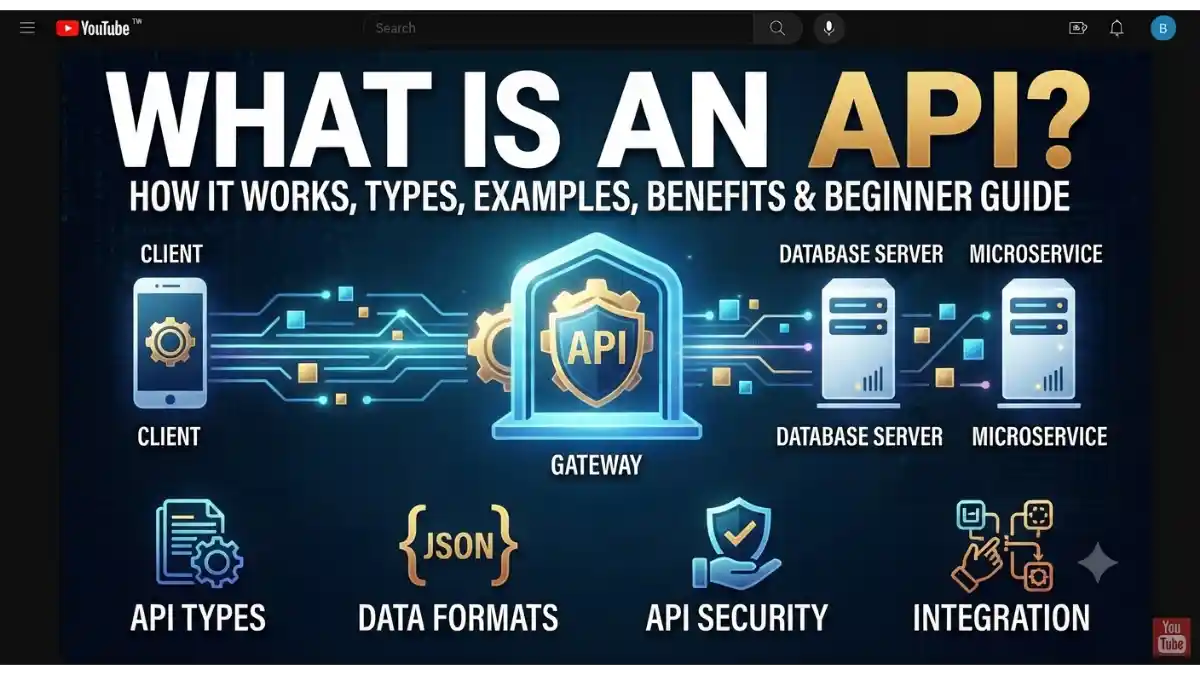
What Is an API?
Have you ever used Google Login to sign in to a website, checked the weather in a mobile app, or made an online payment? Behind the scenes, an API helps these services communicate with each other.
API stands for Application Programming Interface. It is a set of rules and protocols that allows different software applications to communicate and exchange data securely.
In simple words, an API works like a waiter in a restaurant. You place an order (request), the waiter takes it to the kitchen (server), and then brings back your food (response). Similarly, an API takes your request to another application or server and returns the required information.
APIs are used in websites, mobile apps, cloud services, banking systems, e-commerce platforms, social media, and many other digital services.
Table of Contents
- What Is an API?
- Why Are APIs Important?
- How Does an API Work?
- Types of APIs
- API Protocols and Architectures
- Real-World API Examples
- Benefits of APIs
- Common API Use Cases
- API Security Best Practices
- Challenges of Using APIs
- API vs Web Service
- API vs SDK
- Frequently Asked Questions (FAQs)
- Conclusion
Why Are APIs Important?
Modern applications rarely work in isolation. APIs allow them to connect and share data without exposing their internal code.
Reasons Why APIs Matter
- Enable communication between applications
- Save development time
- Support automation
- Improve user experience
- Allow integration with third-party services
- Help businesses build scalable systems
- Make cloud services possible
Without APIs, developers would have to build every feature from scratch.
How Does an API Work?
An API follows a simple request-and-response process.
Step 1: User Makes a Request
A user opens an app or website and performs an action, such as checking the weather.
Step 2: Application Sends an API Request
The application sends a request to the API.
Step 3: API Contacts the Server
The API forwards the request to the appropriate server or service.
Step 4: Server Processes the Request
The server retrieves the requested information.
Step 5: API Returns the Response
The API sends the data back to the application, which displays it to the user.
Types of APIs
APIs can be categorized based on who can access them.
1. Public APIs
Public APIs are available for anyone to use.
Examples:
- OpenWeather API
- Google Maps APIs (with applicable terms and quotas)
- News APIs
2. Private APIs
Private APIs are used only within an organization.
Businesses use them to connect internal systems securely.
3. Partner APIs
Partner APIs are shared with approved business partners.
They usually require authorization and agreements.
4. Composite APIs
Composite APIs combine multiple API requests into one call.
They help improve performance and reduce network requests.
API Protocols and Architectures
Different APIs use different communication styles.
REST API
REST (Representational State Transfer) is the most widely used API architecture.
Features:
- Uses HTTP methods
- Lightweight
- Easy to use
- Often exchanges data in JSON format
SOAP API
SOAP (Simple Object Access Protocol) is a protocol used in enterprise applications.
Features:
- XML-based
- Strong security standards
- Common in banking and healthcare systems
GraphQL
GraphQL is a query language and runtime for APIs.
Advantages:
- Clients request only the data they need
- Reduces unnecessary data transfer
- Flexible queries
gRPC
gRPC is a high-performance framework developed by Google.
It is commonly used for communication between microservices.
Real-World API Examples
APIs are used every day, often without users realizing it.
Google Maps API
Displays maps and navigation inside apps and websites.
Payment APIs
Services like Stripe, PayPal, and Razorpay allow businesses to process online payments securely.
Weather APIs
Apps retrieve live weather information from weather service providers.
Social Media APIs
Platforms like Facebook, X (formerly Twitter), LinkedIn, and Instagram provide APIs that allow approved applications to integrate features, subject to their policies.
Email APIs
Services such as SendGrid and Mailgun help applications send emails automatically.
SMS APIs
Businesses use SMS APIs to send OTPs, alerts, and notifications.
Benefits of APIs
Faster Development
Developers can integrate existing services instead of building everything from scratch.
Better User Experience
Users get access to features like maps, payments, login systems, and notifications seamlessly.
Improved Automation
APIs enable applications to exchange data automatically.
Scalability
APIs help applications grow by connecting with additional services as needed.
Cost Savings
Using existing APIs can reduce development time and maintenance costs.
Easier Integration
Businesses can connect different software systems more efficiently.
Common API Use Cases
APIs power many everyday digital experiences.
Examples include:
- Online payments
- Flight booking
- Food delivery
- Weather forecasts
- Social media login
- Banking applications
- Cloud storage
- Video streaming
- AI-powered applications
- E-commerce websites
API Security Best Practices
Protecting APIs is essential.
Authentication
Verify the identity of users or applications.
Common methods include:
- API Keys
- OAuth 2.0
- JWT (JSON Web Tokens)
Authorization
Ensure users can access only the resources they are permitted to use.
HTTPS Encryption
Always transmit API data over HTTPS to protect it in transit.
Rate Limiting
Limit the number of requests to help prevent abuse and denial-of-service attacks.
Input Validation
Validate incoming data to reduce the risk of attacks such as injection.
Challenges of Using APIs
While APIs offer many benefits, they also have challenges.
Security Risks
Poorly secured APIs can expose sensitive information.
Version Changes
API updates may require developers to modify their applications.
Downtime
If a third-party API becomes unavailable, dependent applications may be affected.
Usage Limits
Many APIs have request limits or paid pricing plans.
API vs Web Service
| Feature | API | Web Service |
| Purpose | Connects software applications | Exchanges data over a network |
| Internet Required | Not always | Usually yes |
| Protocols | REST, GraphQL, gRPC, SOAP, etc. | Commonly SOAP or REST over HTTP |
| Scope | Broader concept | A type of API accessible via web technologies |
API vs SDK
| Feature | API | SDK |
| Meaning | Interface for communication | Software Development Kit |
| Purpose | Enables applications to interact | Provides tools to build applications |
| Includes Tools | No | Yes |
| Includes Documentation | Usually | Yes |
| Example | Google Maps API | Android SDK |
How Beginners Can Start Learning APIs
If you’re new to APIs, follow these steps:
Learn Basic HTTP Methods
- GET – Retrieve data
- POST – Create data
- PUT – Update data
- DELETE – Remove data
Understand JSON
Most modern APIs exchange data in JSON format.
Try Free APIs
Practice with public APIs such as:
- JSONPlaceholder
- OpenWeather
- REST Countries
Use API Testing Tools
Popular tools include:
- Postman
- Insomnia
- Bruno
Read API Documentation
Good documentation explains endpoints, authentication, request formats, and response examples.
Frequently Asked Questions (FAQs)
What is an API in simple words?
An API (Application Programming Interface) is a bridge that allows different software applications to communicate and share data with each other.
What is the most common type of API?
REST APIs are the most commonly used because they are simple, flexible, and widely supported.
Do APIs require the internet?
Not always. Some APIs work locally within a system, while web APIs communicate over the internet or private networks.
Is an API a programming language?
No. An API is an interface or set of rules for communication, not a programming language.
Can beginners learn APIs?
Yes. With basic knowledge of HTTP, JSON, and simple API testing tools, beginners can start learning and using APIs.
Conclusion
APIs are a fundamental part of modern software development. They enable applications to communicate, share data, and provide powerful features such as online payments, maps, weather updates, social media login, and cloud services.
By understanding how APIs work, the different types available, and basic security practices, beginners can build a strong foundation for web and app development. Whether you’re a developer, business owner, or technology enthusiast, learning about APIs is an important step toward understanding today’s connected digital world.