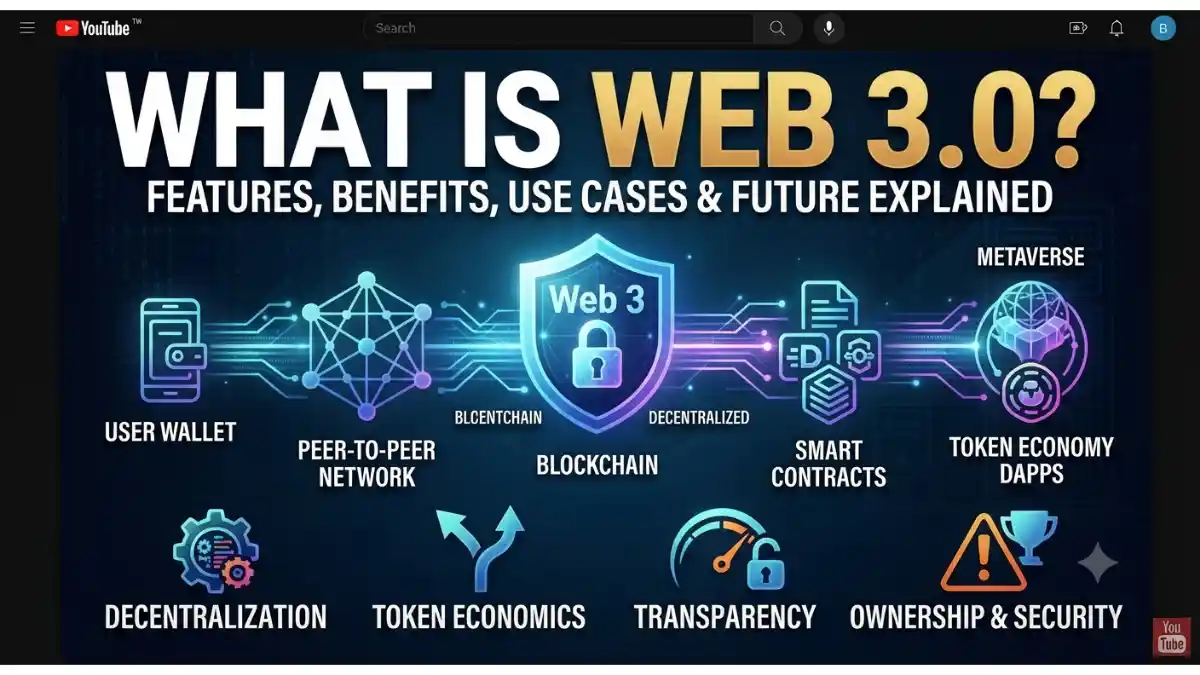
What Is Web 3.0?
The internet has changed a lot over the years. In the beginning, websites only provided information. Later, social media, online shopping, and interactive platforms became popular. Now, the internet is entering a new phase called Web 3.0.
Web 3.0 is the next generation of the internet that focuses on decentralization, user privacy, blockchain technology, and giving users more control over their data and digital assets.
Unlike traditional websites where large companies control most of the data, Web 3.0 aims to let users own their information and interact directly through decentralized technologies.
In simple words, Web 3.0 is a smarter, more secure, and more user-controlled version of the internet.
Table of Contents
- What Is Web 3.0?
- Evolution of the Web
- Why Is Web 3.0 Important?
- How Does Web 3.0 Work?
- Key Features of Web 3.0
- Technologies Behind Web 3.0
- Benefits of Web 3.0
- Real-World Use Cases
- Challenges of Web 3.0
- Web 2.0 vs Web 3.0
- Future of Web 3.0
- Frequently Asked Questions (FAQs)
- Conclusion
Evolution of the Web
To understand Web 3.0, let’s look at how the internet has evolved.
Web 1.0 (Read-Only Internet)
The first version of the internet mainly allowed users to read information.
Characteristics
- Static websites
- Limited interaction
- Basic HTML pages
- Mostly personal or company websites
Web 2.0 (Read and Write Internet)
Web 2.0 introduced user interaction and content creation.
Examples
- YouTube
- Twitter (X)
- Wikipedia
Characteristics
- Social media
- Online shopping
- Blogging
- Cloud services
- User-generated content
Web 3.0 (Read, Write and Own)
Web 3.0 gives users greater control over their identity, data, and digital assets using decentralized technologies.
Characteristics
- Decentralized applications (DApps)
- Blockchain technology
- Smart contracts
- Digital wallets
- Greater user control
- Token-based ecosystems
Why Is Web 3.0 Important?
Many current online services store large amounts of user data on centralized servers. Web 3.0 aims to reduce dependence on centralized control by using distributed networks.
Reasons Why Web 3.0 Matters
- Gives users more control over their data
- Improves transparency
- Reduces single points of failure
- Supports decentralized finance (DeFi)
- Enables digital ownership through blockchain
- Creates new business models
- Encourages innovation
How Does Web 3.0 Work?
Web 3.0 combines several technologies to build decentralized applications and services.
A typical process looks like this:
- A user connects with a digital wallet.
- The application interacts with a blockchain network.
- Smart contracts execute predefined rules automatically.
- Transactions are verified by the blockchain.
- Data is distributed across many computers instead of a single server.
This approach can reduce reliance on central authorities for certain types of applications.
Key Features of Web 3.0
Decentralization
Instead of storing information on one central server, Web 3.0 applications often distribute data across many computers.
Blockchain Technology
Blockchain records transactions in a transparent and tamper-resistant way.
Popular blockchain platforms include:
- Ethereum
- Solana
- Polygon
- Avalanche
- BNB Chain
Smart Contracts
Smart contracts are self-executing programs stored on a blockchain.
They automatically perform actions when predefined conditions are met.
User Ownership
Users can own digital assets, identities, or tokens directly through cryptographic wallets.
Privacy
Many Web 3.0 projects aim to give users more control over their personal information, though privacy depends on the specific platform and blockchain design.
Interoperability
Some Web 3.0 applications are designed to work across multiple blockchain networks and services.
Technologies Behind Web 3.0
Several technologies make Web 3.0 possible.
Blockchain
Provides secure and distributed record-keeping.
Smart Contracts
Automate agreements without requiring manual execution.
Cryptocurrencies
Used for payments, governance, and incentives in many Web 3.0 ecosystems.
Examples:
- Bitcoin
- Ethereum (ETH)
- Solana (SOL)
NFTs (Non-Fungible Tokens)
Represent ownership of unique digital assets such as artwork, collectibles, or in-game items.
Artificial Intelligence (AI)
AI can improve search, recommendations, automation, and personalization in Web 3.0 applications.
Decentralized Storage
Examples include:
- IPFS
- Filecoin
- Arweave
These systems distribute files across networks instead of relying on a single provider.
Benefits of Web 3.0
Better Data Control
Users may have greater control over how their data is stored and shared.
Improved Security
Decentralized systems can reduce certain risks associated with centralized servers.
Transparency
Blockchain transactions are often publicly verifiable.
Digital Ownership
Users can directly own digital assets such as cryptocurrencies, NFTs, or blockchain-based identities.
Fewer Intermediaries
Some services can operate without traditional middlemen through smart contracts.
Global Accessibility
Many Web 3.0 applications are available to anyone with an internet connection and a compatible wallet.
Real-World Use Cases
Web 3.0 is already being used in many industries.
Decentralized Finance (DeFi)
Users can lend, borrow, trade, and earn interest through blockchain-based financial applications.
NFT Marketplaces
Creators can sell digital art, music, collectibles, and virtual items.
Blockchain Gaming
Players can own and trade in-game assets.
Supply Chain Management
Blockchain can help improve transparency and traceability of products.
Digital Identity
Users can manage digital identities with greater control.
Healthcare
Blockchain may help improve the secure sharing and verification of medical records.
Challenges of Web 3.0
Despite its potential, Web 3.0 also faces challenges.
Scalability
Some blockchain networks struggle to process large numbers of transactions quickly.
User Experience
Many Web 3.0 applications can still be difficult for beginners to use.
Regulation
Governments around the world are still developing regulations for blockchain and digital assets.
Security Risks
Poorly written smart contracts, phishing attacks, and wallet theft can lead to financial losses.
Energy Consumption
Some blockchain networks consume significant energy, although many newer networks use more energy-efficient consensus mechanisms.
Web 2.0 vs Web 3.0
| Feature | Web 2.0 | Web 3.0 |
| Data Control | Companies | Users have greater control |
| Storage | Centralized | Often Decentralized |
| Identity | Platform Accounts | Digital Wallets |
| Payments | Banks & Gateways | Blockchain & Crypto (where supported) |
| Ownership | Platform-Controlled | User-Owned Digital Assets |
| Transparency | Limited | Often Higher Through Blockchain |
Future of Web 3.0
Web 3.0 is still developing, but many experts believe it could reshape parts of the internet over time.
Future trends may include:
- Wider blockchain adoption
- More decentralized applications (DApps)
- Growth of decentralized finance (DeFi)
- Better interoperability between blockchains
- AI-powered decentralized services
- Improved digital identity systems
- Expansion of tokenized assets
The pace and extent of adoption will depend on technological improvements, regulation, usability, and user demand.
Frequently Asked Questions (FAQs)
What is Web 3.0 in simple words?
Web 3.0 is the next generation of the internet that uses decentralized technologies like blockchain to give users more control over their data and digital assets.
Is Web 3.0 the same as blockchain?
No. Blockchain is one of the core technologies that enables many Web 3.0 applications, but Web 3.0 also includes technologies such as smart contracts, decentralized storage, AI, and digital identity.
What are DApps?
DApps (Decentralized Applications) are applications that run on blockchain or decentralized networks instead of relying entirely on centralized servers.
Is cryptocurrency required to use Web 3.0?
Not always. Some Web 3.0 applications require a crypto wallet or tokens, while others allow limited access without owning cryptocurrency.
Is Web 3.0 replacing Web 2.0?
Not at present. Web 3.0 is emerging alongside Web 2.0, and many services combine elements of both rather than replacing existing systems completely.
Conclusion
Web 3.0 represents an important step in the evolution of the internet by emphasizing decentralization, transparency, and greater user control. Through technologies such as blockchain, smart contracts, decentralized storage, and digital wallets, it introduces new ways to interact, own digital assets, and build online services.
Although challenges like scalability, regulation, and usability remain, Web 3.0 continues to grow across industries such as finance, gaming, digital identity, and supply chain management. Understanding its concepts today can help individuals and businesses prepare for the future of the internet.