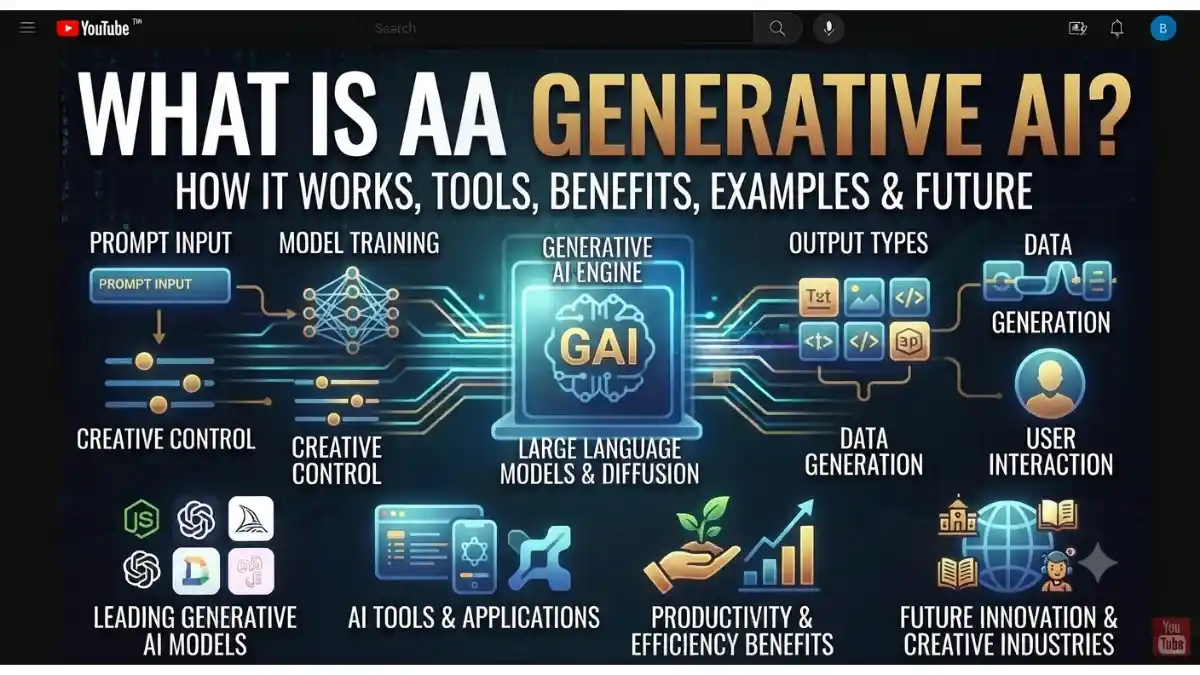
What Is Generative AI?
Artificial Intelligence (AI) is transforming the way people work, learn, and create content. One of the most exciting branches of AI is Generative AI, which can create new content such as text, images, videos, music, code, and even 3D designs based on user prompts.
Generative AI is a type of Artificial Intelligence that learns patterns from large datasets and generates new, original content that resembles what it has learned.
In simple words, Generative AI is like a smart digital creator. You give it a prompt or instruction, and it can generate articles, images, presentations, computer code, marketing content, or other creative outputs within seconds.
Today, Generative AI is used by students, businesses, developers, designers, marketers, researchers, and content creators around the world.
Table of Contents
- What Is Generative AI?
- Why Is Generative AI Important?
- How Does Generative AI Work?
- Key Technologies Behind Generative AI
- Types of Generative AI
- Popular Generative AI Tools
- Benefits of Generative AI
- Real-World Applications
- Challenges and Risks
- Best Practices for Using Generative AI
- Future of Generative AI
- Frequently Asked Questions (FAQs)
- Conclusion
Why Is Generative AI Important?
Generative AI is changing how people create content and solve problems by making many tasks faster and more accessible.
Reasons Why Generative AI Matters
- Creates content quickly
- Boosts productivity
- Supports creativity and brainstorming
- Helps automate repetitive tasks
- Assists with coding and software development
- Improves customer support
- Enables personalized experiences
- Supports innovation across industries
How Does Generative AI Work?
Generative AI models are trained on large collections of text, images, audio, code, or other data. During training, they learn patterns, relationships, and structures within the data.
A simplified workflow looks like this:
- Large datasets are collected and prepared.
- An AI model is trained to recognize patterns.
- A user enters a prompt or question.
- The model predicts and generates the most appropriate response.
- The output is returned as text, an image, code, audio, or another format.
The quality of the result depends on the model, the prompt, and the context provided.
Key Technologies Behind Generative AI
Several technologies power modern Generative AI systems.
Large Language Models (LLMs)
LLMs are AI models trained on vast amounts of text to understand and generate human-like language.
Examples include models developed by OpenAI, Anthropic, Google, Meta, and others.
Transformer Architecture
Most modern language models use the Transformer architecture, which helps them understand context and relationships between words efficiently.
Diffusion Models
Diffusion models are commonly used for AI image generation by gradually transforming random noise into detailed images.
Neural Networks
Deep neural networks enable AI systems to recognize patterns and generate new content.
Natural Language Processing (NLP)
NLP allows AI to understand, interpret, and generate human language.
Types of Generative AI
Generative AI can create different kinds of content.
Text Generation
Creates:
- Articles
- Emails
- Stories
- Reports
- Summaries
- Marketing content
Image Generation
Generates:
- Digital artwork
- Logos
- Illustrations
- Product mockups
- Social media graphics
Code Generation
Helps developers write, explain, debug, and improve code.
Audio Generation
Can generate:
- Voice narration
- Music
- Sound effects
- Speech synthesis
Video Generation
Creates or assists with:
- AI videos
- Animations
- Marketing videos
- Educational content
Popular Generative AI Tools
Many organizations offer Generative AI tools for different purposes.
AI Chatbots
- ChatGPT
- Claude
- Google Gemini
- Microsoft Copilot
AI Image Generators
- DALL·E
- Midjourney
- Adobe Firefly
- Stable Diffusion
AI Coding Assistants
- GitHub Copilot
- Amazon Q Developer
- Cursor
AI Video Tools
- Runway
- Synthesia
- Pika
AI Design Tools
- Canva AI
- Adobe Express AI
- Figma AI features
Benefits of Generative AI
Saves Time
Generates content much faster than creating everything manually.
Increases Productivity
Helps automate repetitive writing, coding, and design tasks.
Supports Creativity
Provides ideas, drafts, and inspiration for creative projects.
Assists Learning
Explains concepts, summarizes information, and answers questions.
Improves Customer Support
Can power AI assistants that answer common customer queries.
Helps Software Development
Assists with code generation, debugging, documentation, and testing.
Real-World Applications
Generative AI is being used across many industries.
Education
- Personalized learning
- Lesson planning
- Practice questions
- Study guides
Healthcare
- Medical documentation assistance
- Research support
- Administrative automation
AI-generated medical information should always be reviewed by qualified professionals.
Marketing
- Blog writing
- Product descriptions
- Ad copy
- Social media content
Software Development
- Code generation
- Documentation
- Bug detection
- Code explanation
Customer Service
- AI chatbots
- Virtual assistants
- Automated responses
Entertainment
- Story writing
- Music creation
- Game content
- Visual effects
Challenges and Risks
While Generative AI offers many benefits, it also has limitations.
Incorrect Information
AI models can sometimes generate inaccurate or misleading content, often called hallucinations.
Copyright and Intellectual Property
Users should ensure they have the right to use AI-generated content and respect applicable copyright laws.
Privacy Concerns
Avoid sharing confidential, personal, or sensitive information with AI tools unless you understand how the service handles your data.
Bias
AI systems may reflect biases present in their training data.
Misinformation
AI can be misused to generate convincing but false content, making verification important.
Job Impact
Generative AI is changing many types of work by automating certain tasks while also creating demand for new skills and roles.
Best Practices for Using Generative AI
Use Generative AI responsibly by following these recommendations.
Write Clear Prompts
Specific prompts often produce better results.
Verify Information
Check important facts using reliable sources before relying on AI-generated content.
Protect Sensitive Data
Do not enter confidential business or personal information into AI tools unless appropriate safeguards are in place.
Edit AI Outputs
Review and refine AI-generated content before publishing or sharing it.
Respect Copyright
Understand the licensing and usage terms of the AI tools you use.
Future of Generative AI
Generative AI is expected to become more capable and widely integrated into everyday tools.
Future trends may include:
- More accurate AI assistants
- Better multimodal AI (text, image, audio, and video together)
- Personalized AI experiences
- AI-powered software development
- Smarter business automation
- Improved educational tools
- More advanced healthcare applications
- Greater integration into productivity software
As the technology evolves, responsible development, transparency, and regulation will continue to play an important role.
Generative AI vs Traditional AI
| Feature | Traditional AI | Generative AI |
| Main Purpose | Analyze and predict | Create new content |
| Output | Decisions, classifications | Text, images, code, audio, video |
| Examples | Spam filters, recommendation systems | ChatGPT, DALL·E, Midjourney |
| Creativity | Limited | High |
| User Input | Data | Prompts and instructions |
Frequently Asked Questions (FAQs)
What is Generative AI in simple words?
Generative AI is a type of Artificial Intelligence that creates new content such as text, images, code, music, or videos based on user prompts.
Is ChatGPT a Generative AI tool?
Yes. ChatGPT is a Generative AI application that generates text-based responses and assists with writing, coding, learning, brainstorming, and many other tasks.
Can Generative AI create images?
Yes. Image generation tools such as DALL·E, Midjourney, Adobe Firefly, and Stable Diffusion can create images from text descriptions.
Is Generative AI free?
Some Generative AI tools offer free plans with limited features, while others require paid subscriptions for advanced capabilities.
Will Generative AI replace human jobs?
Generative AI is likely to automate some tasks and change how many jobs are performed, but it is also expected to create new roles and increase demand for AI-related skills. Human expertise, creativity, judgment, and oversight remain important in many fields.
Conclusion
Generative AI is one of the most significant advances in artificial intelligence, enabling people to create text, images, code, audio, and videos with remarkable speed and efficiency. From education and software development to healthcare, marketing, and customer service, its applications continue to expand.
While Generative AI offers powerful productivity and creativity benefits, it should be used responsibly by verifying important information, protecting sensitive data, and reviewing AI-generated outputs. Understanding how Generative AI works and its strengths and limitations will help individuals and businesses make the most of this rapidly evolving technology.